

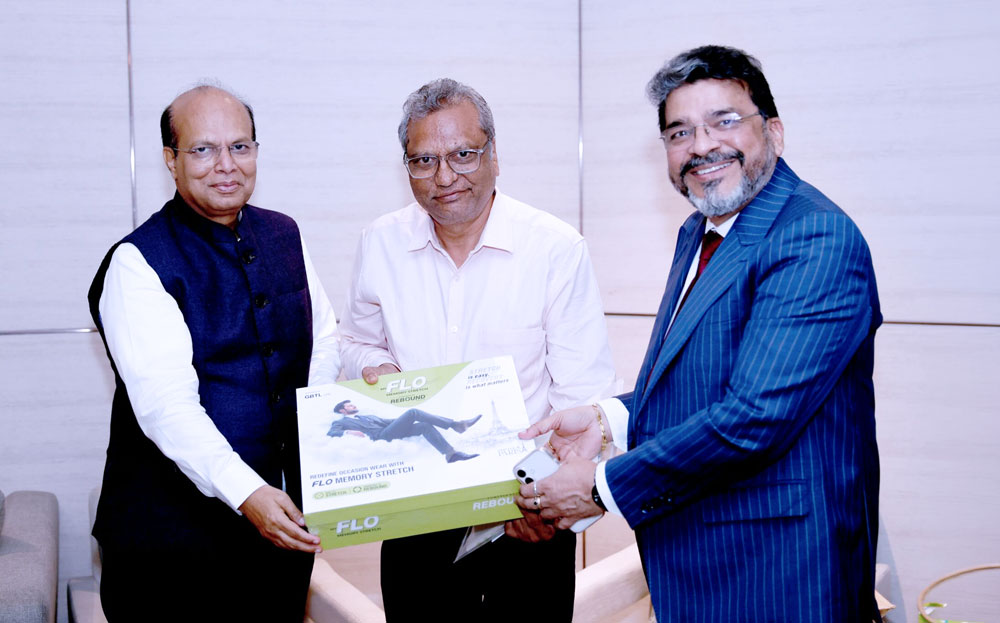
India-based GBTL has introduced FLO Memory Stretch, a fabric platform designed to bring greater freedom of movement to tailored garments while helping them retain their shape through repeated wear. Built around the company’s proprietary Rebound Tech, the range targets applications spanning business and everyday wear to travel, leisure, parties and weddings.
The launch reflects a shift in how stretch fabrics are being positioned in the tailoring market. While stretch is traditionally promoted in terms of how much a fabric can extend when the wearer sits, bends or moves, GBTL is placing greater emphasis on what happens after that movement: how effectively the fabric recovers its original dimensions.
From stretch to recovery
Elastic recovery can be particularly important in tailored garments, where repeated movement can gradually affect fit and appearance. Trousers may develop unwanted growth around the knees and seat, while jackets can lose their original shape around the elbows and other high-movement areas.
According to GBTL, Rebound Tech is designed to allow garments to move naturally while helping them retain their structure, drape and visual appeal over extended use. The company is positioning this combination of mobility and shape retention as a key differentiator for suiting and occasion wear.
The approach also addresses a broader consumer expectation: garments that can transition between different settings without compromising appearance. For business travelers and consumers seeking versatile wardrobes, fabrics that combine comfort with lasting structure can offer a practical advantage.
However, GBTL has not publicly disclosed detailed technical specifications for FLO Memory Stretch, including fiber composition, stretch percentage, recovery rate, testing methodology, wash durability or comparative performance data. As a result, the performance claims remain manufacturer statements until supported by standardized laboratory testing and garment-wear trials.
Six collections for different occasions
Rather than presenting FLO as a single construction for every end use, GBTL has divided the platform into six occasion-focused collections. This allows characteristics such as fabric weight, handle, color, drape and stretch behavior to be adapted according to the intended application while retaining the common focus on recovery.
The collections are aimed at business, everyday, travel, leisure, party and wedding wear, reflecting the growing overlap between formal tailoring and more versatile lifestyle clothing.
The company has described the platform as ‘crafted in Paris and engineered in India,’ combining international styling input with its domestic manufacturing and product-development capabilities. GBTL, formerly known as Grasim Bhiwani Textiles, operates within the Donear Group following its acquisition in 2017 and has a portfolio focused on formal and semi-casual fabrics.
Linking fabrics with fashion direction
Alongside the fabric platform, GBTL unveiled FLO CAST, a biannual journal covering colors, materials, silhouettes and consumer preferences. The first edition covers the July 2026 to January 2027 period and is intended to support retailers and manufacturers in aligning fabric selection and purchasing decisions with emerging fashion trends.
The combination of a performance-oriented fabric platform and a fashion-forecasting publication points to a broader strategy: positioning GBTL not only as a fabric supplier but also as a partner in product development and seasonal planning.
For FLO Memory Stretch, however, the long-term test will be performance in real-world use. Demonstrating consistent recovery after repeated stretching, laundering and wear will be important to establishing the technology as more than a marketing proposition. Equally, tailors and garment manufacturers will need to see that the fabrics can be processed using existing production practices without adding significant complexity or cost.
If these practical and technical requirements are met, GBTL’s recovery-focused approach could give stretch suiting a more defined performance proposition – one centered not simply on how far a fabric moves, but on how well it returns to form.