

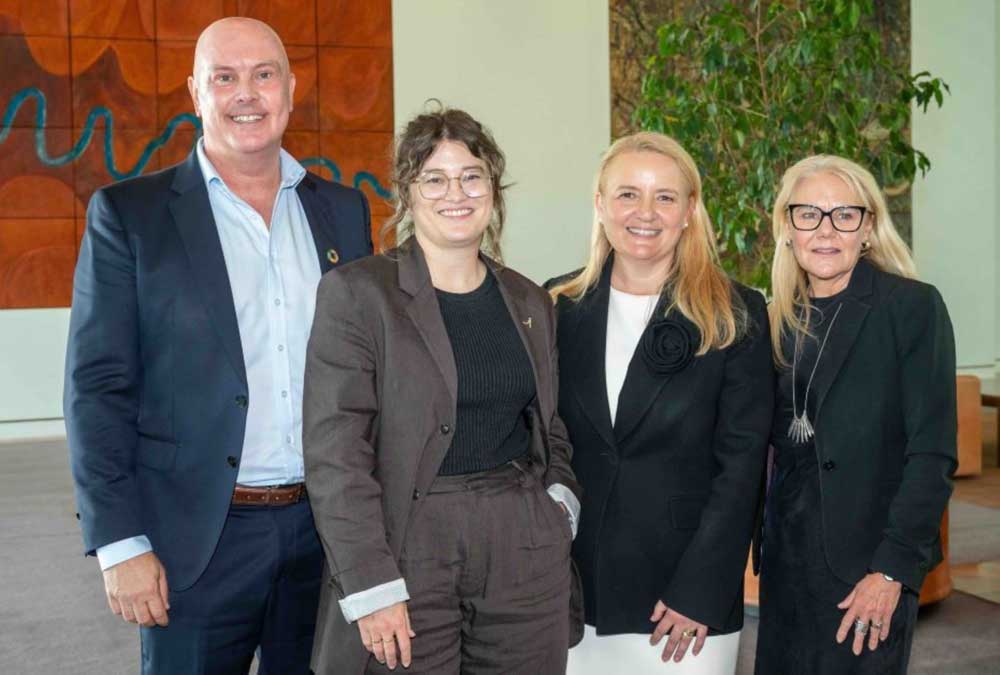
The Australian Fashion Council (AFC) has commissioned a landmark feasibility study to establish a first-of-its-kind Clothing Smart Factory in Australia, a nationally significant step towards rebuilding sovereign capability and creating a new generation of advanced fashion manufacturing. The study is backed by global technology leader Epson, the AFC’s strategic print and projection partner supporting the digital textile printing capability and supported by Investment NSW through its Fostering Innovation Sponsorship Program.
A Clothing Smart Factory is a next-generation, technology-enabled manufacturing facility designed to bring onshore garment production back for Australian brands. The purpose-built manufacturing incubator will allow brands to test ideas, conduct R&D, and run small production at a scale and cost that is currently unviable onshore.
The study brings together a research consortium of three of Australia’s leading universities— Royal Melbourne Institute of Technology (RMIT), Swinburne University of Technology, and University of Technology Sydney (UTS), combining deep expertise across advanced manufacturing, textile technology and the emerging skills needed to power the fashion industry’s digital transformation.
Epson is helping drive the future of onshore garment manufacturing through its Monna Lisa direct-to-fabric digital textile printing technology. Designed for on-demand manufacturing, the technology helps reduce waste, lower water and energy consumption, and shorten supply chains – supporting a more sustainable and responsive fashion industry. Featuring precision print technology and water-based pigment inks, the Monna Lisa series enables brands to produce locally, respond more quickly to changing consumer trends, and improve production efficiency while enhancing creative flexibility making local manufacturing more commercially viable.
The Smart Factory will investigate a Cut, Make and Trim (CMT) facility equipped with digital pattern making, digital textile printing, CNC cutting, automated production line machinery and advanced finishing technologies. The final study will deliver a blueprint to establish a smart factory in NSW, assessing market demand, technical requirements, workforce and skills, financial modelling and opportunities for government and industry co-investment.
The initiative is directly aligned with the NSW Government’s Fashion Sector Strategy, which signals strong appetite for investment in the sector and a priority for the state. The AFC’s longer-term ambition is a scalable, replicable model that could underpin a national network of smart factories over the coming decade.
Together with the AFC’s work across Australian Fashion Week, Global Gateways export development, workforce capability and the National Manufacturing Strategy, the Clothing Smart Factory represents another pillar in rebuilding Australia’s fashion ecosystem from design through to manufacturing and global market access.
The study is expected to be completed in late 2026, ahead of an AFC-hosted industry launch event.




Bed sheets Duvet cover Fitted sheets Pet bad Pillows PC FABRIC COTTON FABRIC POLESTAR FABRIC Export
HANI TEX
sajidaltaf@gmail.com
amir@hanitex.com
https://hanitex.pk
pakistan Faisalabad ::92307.4810795/92316.7370044