
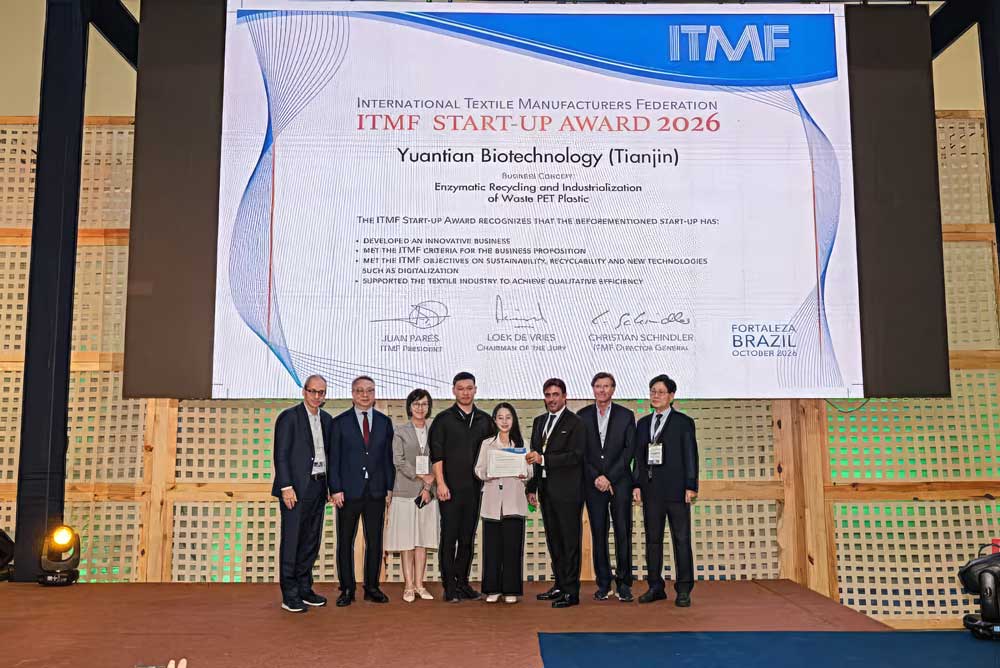
Archibio, named in the award announcement as Yuantian Biotechnology (Tianjin), has received the ITMF Start-up Award 2026 for its work in enzymatic recycling and the industrialization of waste PET plastic. The company was the only Chinese recipient among five winners worldwide and received the award at the ITMF & IAF Conference in Fortaleza, Brazil, held on 14–15 October 2026.
According to the company, a production line with a planned capacity of 6,500 metric tons per year is under construction and is expected to begin operations by the end of 2026. The project builds on a pilot facility with an annual recycled purified terephthalic acid (rPTA) capacity of 300 metric tons, which has been operating for two years.
Founded in 1904, the International Textile Manufacturers Federation recognizes start-ups developing products and processes that improve the textile industry. Its award criteria assess technology, product value and scalability, and market potential. The selection brings international industry recognition to Archibio’s efforts to turn waste polyester into feedstock for new materials.
Recovering polyester from blended textile waste
Archibio’s process uses engineered enzymes to break down polyethylene terephthalate (PET), the polymer used to make polyester. The process recovers terephthalic acid and ethylene glycol, the chemical building blocks of PET. After purification, the recycled monomers, rPTA and rEG, can be repolymerized into the company’s RBPET recycled polyester.
The process can handle polyester-containing blends, including polyester-cotton and polyester-elastane fabrics. By targeting the PET component, the technology creates a route for recovering polyester from mixed textile waste and returning it to material production. This expands the feedstock options available for textile-to-textile recycling.
The company describes RBPET as offering quality comparable to virgin polyester. Its approach is intended to preserve material value through molecular-level recovery, allowing textile waste to replace fossil-based feedstock in the production of new polyester. For textile manufacturers and brands, the objective is a recycled material that can meet performance requirements while supporting circular sourcing.
Building an integrated route to industrial production
Archibio’s enzyme-engineering research began in 2017. The company has since built an enzyme library containing more than 500,000 samples and uses AI-assisted screening to guide enzyme development. This research underpins the proprietary enzymes used in its recycling process.
The company’s development work extends from enzyme design to process engineering and production-line design. Bringing these capabilities together is central to its scale-up strategy: enzyme performance must translate into a process that can operate beyond the laboratory and produce materials for downstream manufacturing.
Archibio also reports Global Recycled Standard (GRS) and OEKO-TEX ECO PASSPORT certifications and more than 50 invention patent applications. Together with its operating pilot facility, these milestones form the basis for the next stage of industrial development.
Following the award, the company is focused on completing its new production line and advancing applications for recycled polyester. The planned expansion is intended to bring its enzyme-based recycling process to a larger scale and support the use of textile waste as a resource for new polyester products.