
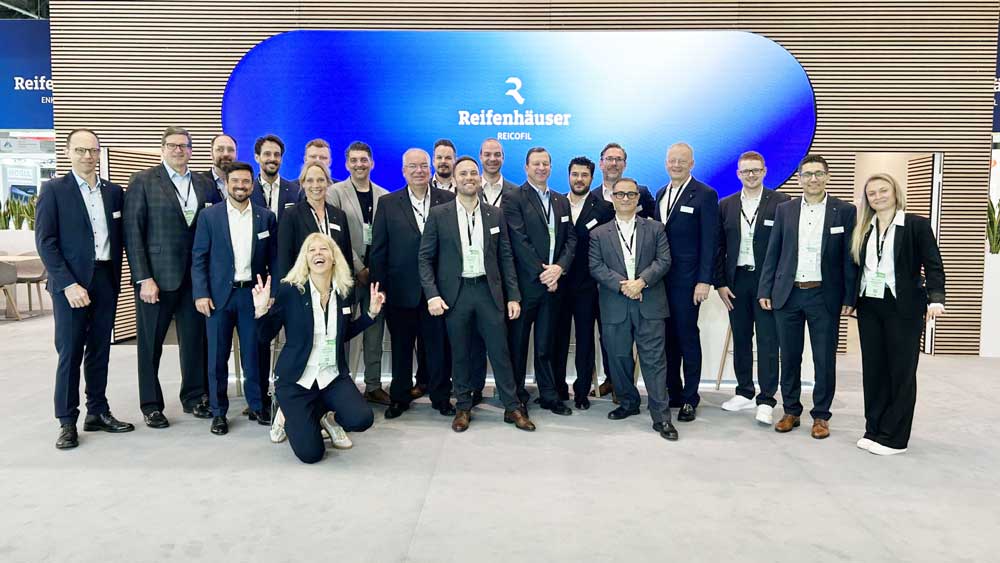
Reifenhäuser Reicofil presented its latest developments in spunbond, meltblown, and composite nonwoven production technologies at INDEX 2026 in Geneva, introducing new products and upgrades under three themes – ‘Grow Together’, ‘Expand Together’, and ‘Transform Together’ – aimed at helping customers improve profitability, enter new markets, and expand the scope of filament-based technologies.
RF 5.10 upgrade delivers higher output
A key highlight at the event was the RF 5.10, an upgrade to the company’s RF5 technology platform. According to Reicofil, the upgrade delivers at least 10% higher production output while improving nonwoven quality and operational reliability. Enhancements to laydown quality and spinning stability within the production line are said to reduce spinning defects and increase machine uptime. The RF 5.10 is available for new installations as well as a retrofit option for existing Reicofil lines.
Entry-level platform targets new producers
Reicofil also introduced RF Core, a standardized entry-level production platform based on its RF4 technology. Designed as an SS(MM)S 3200 mm production line, RF Core is positioned for manufacturers seeking a lower-investment entry point into nonwovens production. The company said the platform combines production efficiency with simplified operation, drawing on Reicofil’s existing process expertise.
Digital tools address skills gap
Digitalization was a prominent theme at the stand, with Reicofil unveiling two automation-focused tools under its RF Smart Assistants range. The S2P (Spinning-to-Production) Assistant automates critical production phases, standardizes workflows, and reduces ramp-up times by digitally capturing process knowledge, enabling operators at varying experience levels to achieve consistent production results.
The Smart Alarm Manager introduces intelligent alarm prioritization and incorporates an AI-powered chatbot based on Reifenhäuser Next.AI technology. The system provides real-time recommendations for troubleshooting, maintenance, and process optimization, according to the company.
XHL technology targets hygiene segment
Among the application-specific developments showcased was XHL (Extra High Loft) technology, which the company said enables manufacturers to produce soft, bulky, and drapeable nonwovens for hygiene applications. The technology uses highly crimped bicomponent fibers with reduced diameters to deliver greater fabric thickness, improved softness, and enhanced abrasion resistance. Reicofil added that XHL also supports sustainability goals by reducing raw material consumption, enabling mono-material recyclable structures, and lowering energy use during production.
MPM technology for wipes manufacturing
Reicofil also presented its MPM (Meltblown-Pulp-Meltblown) technology for wipes production. The company said the process combines pulp dispersion capabilities with a compact machine design that reduces building and equipment investment requirements. The platform allows manufacturers to incorporate various additives to customize product properties.
Filament technologies beyond nonwovens
Under the ‘Transform Together’ initiative, Reicofil said it is working with partners to develop filament-based solutions that process materials including polymers, ceramics, and proteins for applications beyond conventional nonwovens. Simon Finianos, sales director, noted that the initiative reflects the broader potential of filament technologies for advanced technical materials.