

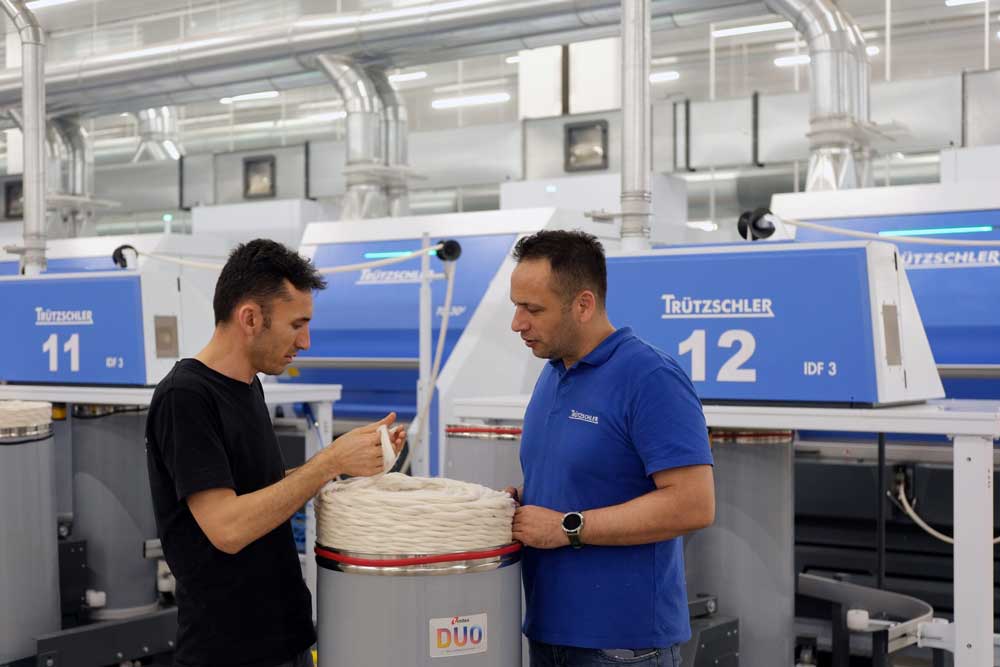
Trützschler’s integrated draw frame IDF 3, when paired with the TC 30i card, delivered productivity increases of up to 67% and measurably lower IPI levels across multiple customer trials at Turkish spinning mills under production conditions, according to the company.
TC 30i and IDF 3 results
One Turkish spinning mill producing 100% cotton rotor yarn (Ne 30/1) compared a conventional setup – one breaker and one finisher draw frame running at 90 kg/h – against the TC 30i card combined with the IDF 3. The combination enabled stepwise production increases to 130 kg/h and subsequently to 150 kg/h. Across all trials, the company said, the combination delivered higher and more consistent quality with lower IPI levels.
A second customer operates TC 30i cards with IDF 3 in a rotor spinning line processing cotton and cotton blends. The setup is said to shorten the process and deliver a 33% increase in productivity compared to a conventional competitor setup comprising a breaker and a finisher draw frame, while maintaining consistent quality.
Performance with the TC 19i card
A third Turkish mill conducted trials using the IDF 3 with a TC 19i card, processing a blend of 50% cotton waste and 50% polyester. At 130 kg/h, the IDF 3 setup reduced IPI levels by around 50% compared to a conventional two-passage draw frame setup. According to Trützschler, IPI values achieved with the IDF 3 remained below those of the conventional process even when production was raised to 220 kg/h. The mill subsequently decided to replace competitor cards and draw frames with the TC 30i and IDF 3.
Design and process rationale
The IDF 3 operates with a single drafting zone, in contrast to the two drafting zones used in conventional draw frames. The company says this design, combined with a specific drafting zone geometry, reduces floating fibers and minimizes count variations – effects it says are more pronounced when processing shorter fibers or higher proportions of short fiber content. When combined with the TC 30i, Trützschler says the pairing also reduces space requirements, compressed air consumption and operator effort, and maintains throughput during can changes.