

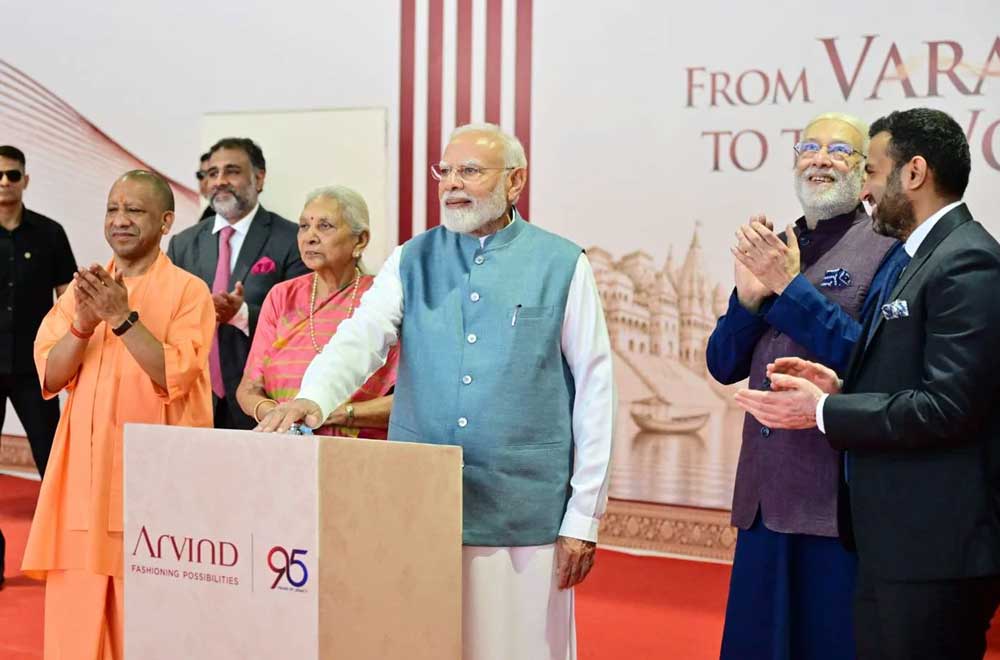
Prime Minister Narendra Modi has inaugurated Arvind’s garment manufacturing facility in Varanasi, Uttar Pradesh, the company’s first manufacturing unit in the state. Developed with an investment of approximately INR 150 crore, the plant will make knitwear products using automated sewing technologies and is expected to employ over 1,000 people, predominantly women.
Uttar Pradesh Governor Anandiben Patel and Chief Minister Yogi Adityanath were present at the inaugural session, along with senior government officials and industry leaders.
The facility is spread over 5.5 acres, with a total built-up area of approximately 65,000 sq ft. According to the company, it has a revenue potential of Rs 250 crore. It will manufacture essential knitwear products.
Modi was received by Arvind chairman Sanjay Lalbhai and vice chairmen Punit Lalbhai and Kulin Lalbhai, who accompanied him during the inauguration and a tour of the facility.
Speaking on the occasion, Sanjay Lalbhai said, “We are deeply honored to have the Hon’ble Prime Minister inaugurate this facility.”
He continued, “The Lalbhai Group’s journey of 130 years began in 1897 and has remained closely intertwined with India’s industrial progress. Inspired by the vision of Kasturbhai Lalbhai, we have consistently invested in enterprises that contribute to economic growth, employment generation and nation-building. We are particularly proud that this investment will create large-scale employment opportunities, with women expected to form a significant part of the workforce, reflecting the transformative power of Nari Shak in driving India’s growth story. We are proud to partner in India’s development journey through investment, innovation and job creation.”
Punit Lalbhai said, “With a strong textile value chain, a skilled workforce and growing global demand for diversified sourcing, India is well positioned to emerge as a preferred manufacturing destination for the world. Sustained investments in capacity, productivity, sustainability and workforce development will be critical to realizing this opportunity. We are happy that this facility will contribute to the local economy with a multiplier impact through local employment generation, local sourcing of goods and services and a secondary impact on the ecosystem of moving workforce back home through reverse migration. At Arvind, we remain committed to contributing to this growth story by building globally competitive manufacturing capabilities that create long-term value and employment.”
Kulin Lalbhai added, “Uttar Pradesh is rapidly establishing itself as one of India’s most reactive manufacturing destinations. The state’s focus on infrastructure development, industrial growth, connectivity and skill creation is enabling businesses to expand with confidence and scale. As the textile and apparel sector continues to grow, Uttar Pradesh is well positioned to play a pivotal role in strengthening India’s manufacturing ecosystem, creating employment opportunities and a long-term investment.”
The facility adds garment manufacturing capacity to a country with a large textile base. Equipped with automated production systems, the plant is designed, according to the company, to enhance productivity, ensure consistent quality and support scalable manufacturing operations.