
Bangladesh and the Netherlands have signed a memorandum of understanding (MoU) to accelerate the adoption of circular economy practices across Bangladesh’s textile and ready-made garment (RMG) industries, aiming to promote more efficient resource use, reduce industrial waste and encourage recyclable production systems as Bangladesh seeks to strengthen the sustainability and global competitiveness of its textile supply chain.
The agreement covers cooperation across the textile value chain, with a broader focus on green industrialisation, circular production and the development of more sustainable manufacturing practices, according to Bangladesh’s ministry of commerce.
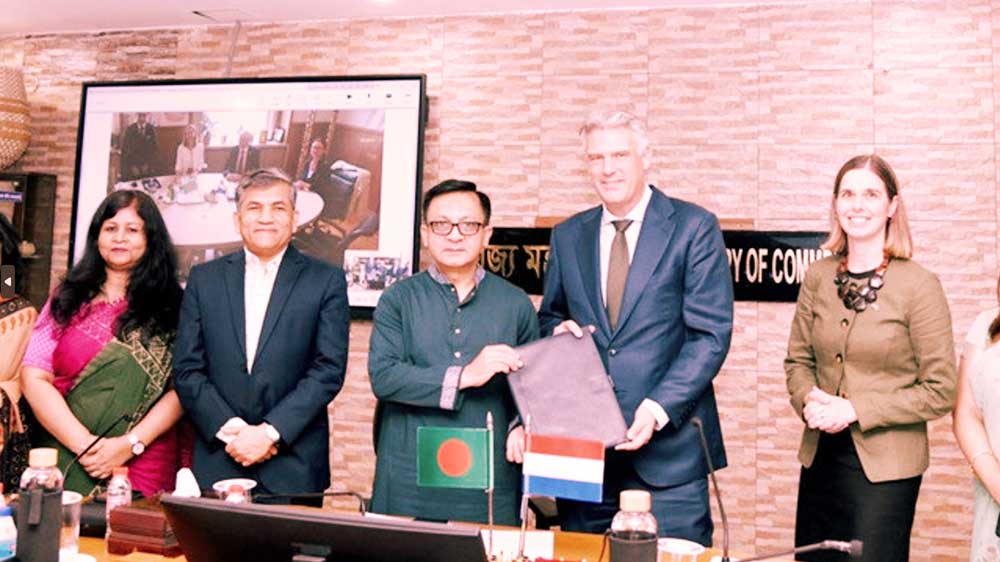
Bangladesh commerce minister Khandakar Abdul Muktadir and Stientje van Veldhoven, minister for climate and green growth of the Netherlands, signed the agreement on behalf of their respective governments during a virtual ceremony.
The partnership comes at a significant time for Bangladesh’s export-oriented textile and apparel industry, which is increasingly facing pressure from international buyers and markets to improve environmental performance and resource efficiency.
Muktadir said circular production and sustainable manufacturing are becoming essential for the global textile industry. Given the deep integration of Bangladesh’s textile and RMG supply chains with international markets, he stressed the need for stronger cross-border cooperation.
He said the MoU could help Bangladesh move towards a greener and more resilient industrial economy while supporting sustainable investment, improving resource efficiency and creating new opportunities for green employment.
Muktadir also linked the initiative to Bangladesh’s transition beyond its least developed country (LDC) status. He noted that stronger environmental performance, cleaner production systems and compliance with evolving international sustainability standards will be increasingly important for maintaining the competitiveness of Bangladesh’s exports.
Van Veldhoven highlighted the international nature of the circular economy transition, noting that individual countries cannot achieve the shift towards more sustainable production systems in isolation, and that greater cooperation among governments, businesses and supply-chain stakeholders will be required.
She said Bangladesh and the Netherlands had already identified potential areas for collaboration and called for these discussions to move towards concrete and measurable actions, while also expressing interest in expanding bilateral cooperation through international platforms.
The MoU is expected to open avenues for greater adoption of green technologies, innovation and resource-efficient production methods in Bangladesh’s textile and RMG industries. Over the longer term, the partnership could support the development of more circular supply chains while helping Bangladeshi manufacturers respond to evolving sustainability requirements in global markets.
For Bangladesh’s textile industry, the initiative also signals a shift from sustainability as a compliance requirement towards circularity as a potential driver of efficiency, innovation and export competitiveness.