

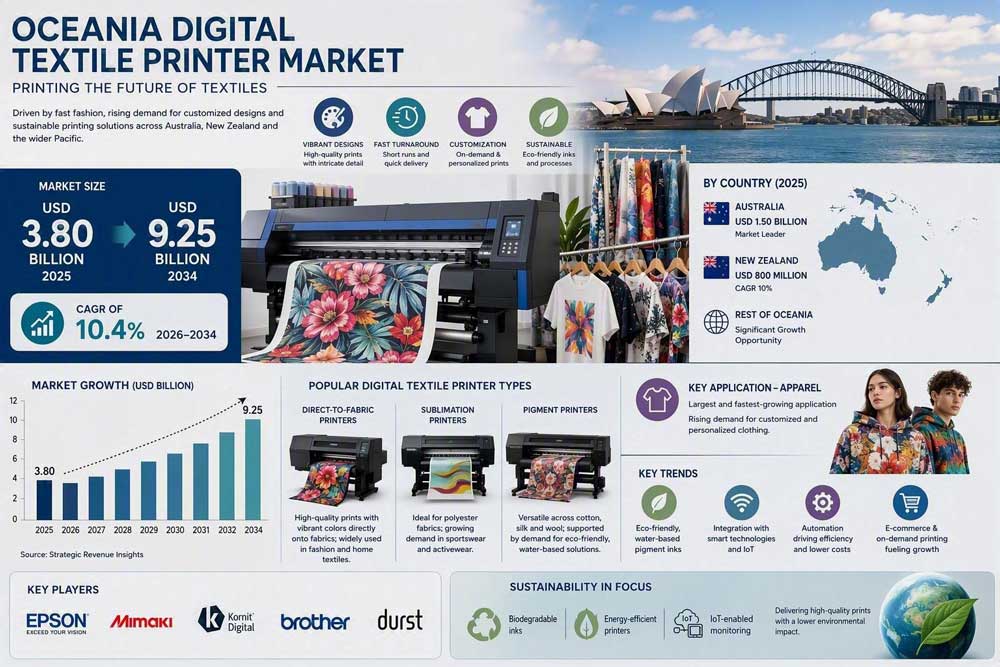
According to Strategic Revenue Insights, a subsidiary of SRI Consulting Group that provides premier data-driven market intelligence, the fast fashion has trained consumers to expect a constant stream of new designs, and traditional textile printing methods simply cannot keep up with that pace, which is why the shift toward digital textile printing across Oceania is accelerating.
The ability to produce vibrant, intricate designs in small batches and short turnaround times is reshaping how the fashion brands, textile mills, and print service providers across Australia, New Zealand, and the wider Pacific approach production. Against this backdrop, the Oceania digital textile printer market was valued at USD 3.80 billion in 2025 and is projected to reach USD 9.25 billion by 2034, growing at a CAGR of 10.4% during the 2026-2034 forecast period. The findings are led by lead analyst Rohan Mehta, whose research combines primary interviews with textile mills, fashion brands, and print service providers with secondary data gathered across the region.
The market is on track to grow from USD 3.80 billion in 2025 to USD 9.25 billion by 2034, a CAGR of 10.4% over 2026-2034. Within the application segment, apparel is both the largest and fastest-growing category, driven by rising demand for customized and personalized clothing. The development of eco-friendly, water-based pigment inks and the integration of digital textile printers with smart technologies and IoT stand out as key trends.
Australia leads the market at USD 1.5 billion, while New Zealand follows closely at USD 800 million and an 10% CAGR as the region’s second-largest market. Epson, Mimaki, and Kornit Digital rank among the leading competitors, alongside Brother and Durst. Consumer appetite for unique, personalized textile products sits at the center of this market’s growth. Buyers are increasingly seeking designs tailored to their individual preferences, and digital textile printers answer that demand by producing high-quality prints with vibrant colors and intricate patterns across a wide range of fabrics, an advantage driving adoption across fashion, home textiles, and signage alike. The trend toward fast fashion and the need for quicker turnaround times are reinforcing this shift.
Technology is making that customization more accessible and more affordable. Improvements in print heads and ink formulations have enhanced both the quality and speed of digital textile printing, while the integration of automation and smart technologies is improving operational efficiency and lowering production costs for businesses adopting these systems. Environmental considerations are shaping ink development in parallel, with water-based pigment inks gaining ground for their lower environmental impact compared with other ink types.
The rise of e-commerce and on-demand printing is compounding these forces, creating sustained demand for the quick, flexible turnaround that digital textile printing enables. Companies investing in biodegradable inks, energy-efficient printers, and IoT-enabled monitoring are positioning themselves to capture this growth as sustainability expectations and production speed requirements continue to rise together.
Direct-to-fabric printers are gaining the most popularity, valued for producing high-quality prints with vibrant colors directly onto textiles, particularly in fashion and home textiles. Sublimation printers are also seeing significant growth, especially suited to polyester fabrics for sportswear and activewear. Pigment printers are gaining traction for their versatility across cotton, silk, and wool, supported by growing demand for eco-friendly, water-based printing solutions.