

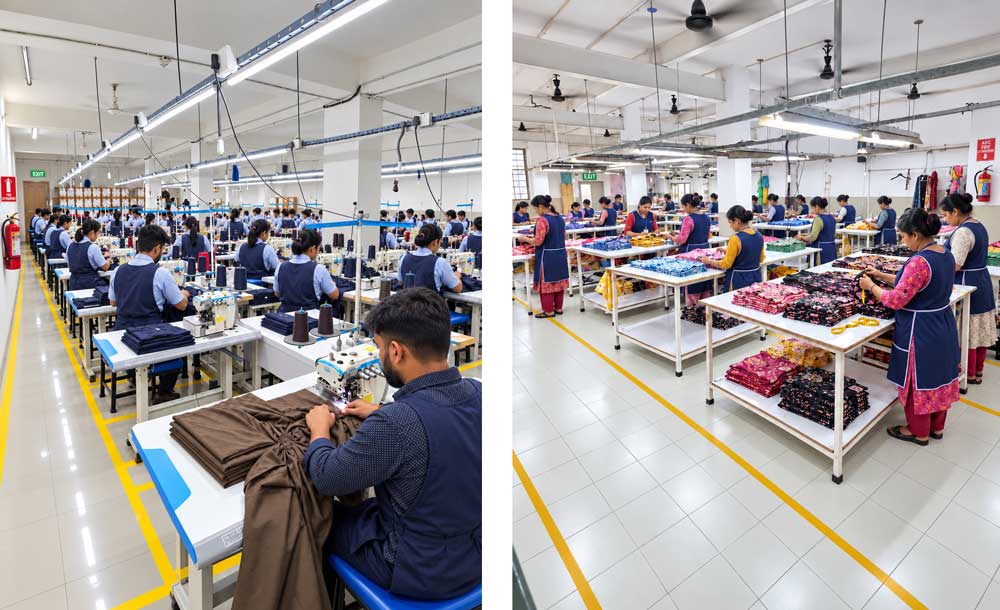
Differences between approved development samples and bulk production, known as production drift, can be reduced when labels write binding preventative instructions into their tech packs, as sample and bulk manufacturing run under different conditions.
Sourcing teams typically approve samples that show fluid drape, soft handfeel, strong print quality and flat hems. When production cartons arrive, bulk fabric may feel stiffer or limper, garment lengths may vary after laundering, bright inks may bleed, hems may ripple and decorative trims may loosen.
Samples are made by master tailors on dedicated sampling machines, while bulk manufacturing relies on industrial line speeds, continuous mechanical tension, automated folders and high-capacity dye vats. Where tech packs leave room for interpretation, factory teams fill the gaps with standard operating assumptions. To limit such differences, labels need to identify the core specification gaps behind drift and write binding preventative instructions into their tech packs.
Yarn and Weave Substitution
What goes wrong: Bulk fabric may show an altered drape, handfeel or opacity compared with the approved sample, feeling coarser, slubby, or thinner and limper.
Why it happens in the factory: Sample yardage is often sourced from open markets or woven on sample handlooms using compact combed yarns. When bulk production begins, weaving mills procure greige cloth that meets only broad, generic descriptions. Carded yarn often replaces combed ring-spun yarn, or weft density drops slightly to speed up output. This alters finished weight and drape without raising visual concerns at the greige stage.
How to specify against it: Tech packs should detail yarn spinning methods, twist direction, plied structure, and nominal warp and weft density. Greige fabric swatches and technical yarn declarations should be required before wet processing begins, with clear fabric weight thresholds set for both raw greige and finished states.
Shrinkage on Loosely Woven Cottons
What goes wrong: Open-weave cottons such as gauze, slub muslin or textured rustic weaves can lose significant dimensional stability on laundering. Garment lengths contract, armholes tighten and side seams twist along the grainline.
Why it happens in the factory: Open-structure yarns stretch under mechanical pull. During industrial dyeing, drying and stenter processing, the cloth travels under continuous tension. When it is wound directly onto cardboard cores, the fibers hold that elongation. If the cutting room spreads yardage and cuts panels immediately, without a dwell period, the stretched yarns remain locked in place until laundering, when they contract.
How to specify against it: Tech packs should call for mechanical pre-shrinking, sanforization or tumble washing before cutting. Bulk rolls should rest flat on cutting tables through a complete tensionless relaxation period before cutting, and pattern markers should compensate for residual shrinkage along the warp and weft directions.
Print Show-Through on Voile
What goes wrong: On delicate cotton voile, muslin or chiffon, the face may show clear artwork while the reverse appears washed out or chalky. In other cases, excess ink bleeds through unevenly, creating cloudy halos on the reverse.
Why it happens in the factory: Sampling takes place on manual flatbed tables with tailored squeegee pressure. Bulk rotary or digital printing operates under uniform mechanical pressure and standardized paste viscosity, formulated primarily for face sharpness. Unless strike-through is identified as a quality requirement, the print house balances viscosity only to prevent surface smudging, which can leave the reverse under-penetrated.
How to specify against it: When working with a scarf manufacturer in India or a garment vendor, the expected level of reverse strike-through on translucent textiles should be stated explicitly. Tech packs should indicate whether the design requires thorough color saturation on both face and back or controlled surface retention. Strike-offs should be evaluated under diffuse transmitted light.
Colorfastness of Bright Reactive Prints
What goes wrong: Deep reactive shades such as vermilion, cobalt or magenta can shed color during home laundering, staining contrast trims, pale grounds or companion garments. Color may also rub off onto skin or undergarments under perspiration.
Why it happens in the factory: Saturated reactive dyeing requires dense dye loading. A portion of the reactive dye hydrolyzes and rests loosely on the fiber surface instead of bonding covalently. In sampling labs, technicians rinse swatches carefully in clean beakers. In high-volume production, mills facing tight schedules or overloaded lines may shorten hot soaping cycles or use saturated rinse baths, leaving hydrolyzed dye on the cloth.
How to specify against it: Tech packs should define post-print washing protocols that require sequential hot soaping and clean cold rinses to strip loose dye. Wet and dry rubbing fastness, domestic wash testing and cross-staining verification on multi-fiber swatches should be mandated before bulk printing begins.
Hem Finishes
What goes wrong: Sample garments may show neat, very thin edges, while bulk shipments show wavy, puckered or fraying hems. Narrow roll hems can pull open, leaving raw threads exposed after wear.
Why it happens in the factory: Sample machinists guide fabric manually and press folds before stitching. In bulk assembly, operators use automatic fold attachments and high-speed sewing machines. If feed dogs pull unevenly, or the attachment size does not match the thickness of the bulk fabric, hems stretch and form fluted ripples. Heavy needle gauges can punch visible holes along lightweight edges, causing structural slippage.
How to specify against it: Tech packs should detail exact hem geometry, fold style, finished width and stitches per inch. They should also specify needle thickness, thread composition and differential feed controls to prevent waving on bias edges, and require stabilizing stay-stitching or temporary wash-away backing on curved panels.
Trim Attachment
What goes wrong: Buttons may loosen, snap fasteners may pull through delicate face fabric, tassel bindings may unravel, and drawstrings may pull out of casings under moderate tension.
Why it happens in the factory: Sample rooms secure trims with generous manual thread wrapping and internal scrap reinforcement behind snaps. Bulk lines use pneumatic presses or automated button attachments calibrated for speed. Operators may omit internal reinforcement behind snaps, skip thread shanks on buttons, or set excessive press pressure that crushes the base weave.
How to specify against it: Construction sheets should include trim attachment diagrams. Buttons should receive lockstitch loops with wound thread shanks for placket clearance, and internal reinforcement patches should be specified behind snaps, grommets and press studs. Tech packs should also state pull-force resistance requirements, bar-tacking on cord exits and back-tacking on decorative ties.
Production Drift Prevention Checklist
For fabric construction, tech packs should specify combed or carded spinning, warp-weft density and greige weight before wet processing. For tension relaxation, they should require mechanical pre-shrinking and mandatory flat relaxation on cutting tables. For translucent fabrics, they should define face-to-back color penetration guidelines under transmitted light. For wash-off, they should demand multi-stage hot soaping and verified rubbing fastness. For hems, they should define fold style, stitches per inch and differential feed settings. For trims, they should require internal backing patches, thread shanks and reinforced anchor stitching.