

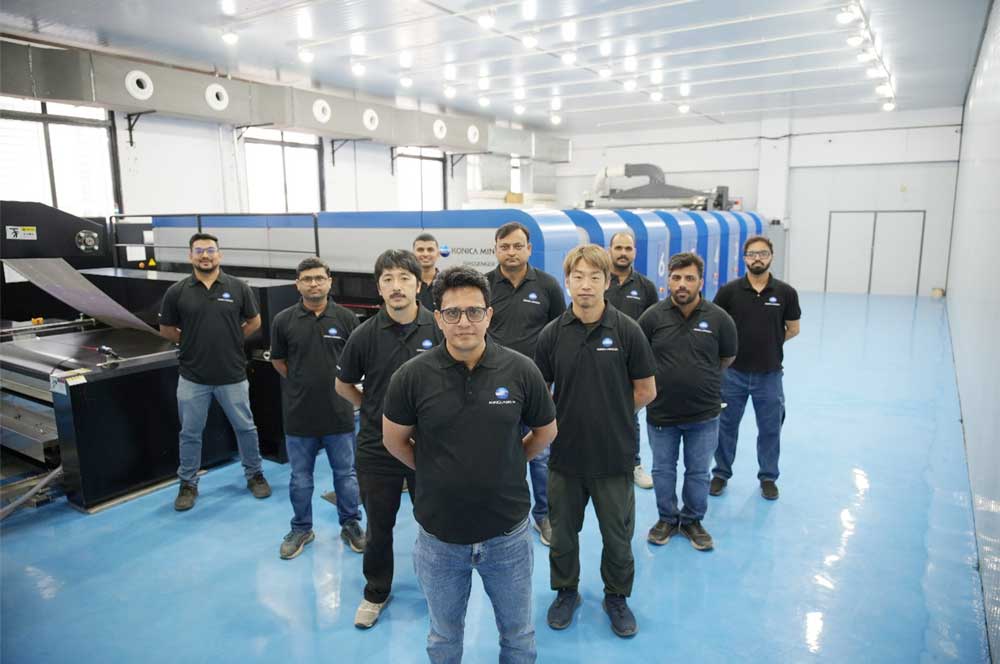
Konica Minolta has installed its NASSENGER SP-1e single-pass digital textile printer in India, marking the first such installation reported in the country, according to the company. Developed using Japanese technology, the machine is designed for high-speed industrial-scale textile production and is said to represent an important milestone for India’s digital textile printing industry.
The NASSENGER SP-1e has a production speed of up to 6,400 sqm/hour and could theoretically produce approximately 153,600 sqm over 24 hours at maximum rated speed, the company said. Actual output would depend on operating conditions, fabric type, print mode, maintenance requirements and production utilisation.
Unlike multi-pass printers, in which the print carriage repeatedly travels across the fabric, the SP-1e uses fixed printing units while the fabric moves continuously beneath them. This single-pass architecture is intended to enable high production speeds and could allow manufacturers to shift long production runs from conventional printing to digital, according to the company. With this capability, digital textile printing is no longer limited to sampling, short runs or boutique production, and can be positioned as part of mainstream industrial textile manufacturing.
Conventional rotary and screen printing have historically underpinned scale in the global textile industry, but market requirements are changing. Fashion cycles are shortening, buyers are reducing inventory levels, designs are changing more frequently, and order quantities are becoming more fragmented, while expectations around quality, sustainability and delivery timelines continue to rise.
Unlike conventional processes that require physical screens, digital textile printing allows manufacturers to move directly from a digital design file to production. This is expected to support a more flexible manufacturing model, with faster design changes, reduced setup dependency, shorter lead times and greater suitability for handling multiple designs and varying order quantities.
The company noted that India has an opportunity to increase its share of global textile and apparel exports, citing the country’s existing capabilities across fibres, yarns, weaving, knitting, processing, garmenting, skilled manpower and one of the world’s largest textile manufacturing ecosystems. According to the company, the SP-1e’s significance lies not only in its speed but in its combination of industrial productivity, digital flexibility, repeatability and Japanese engineering.