
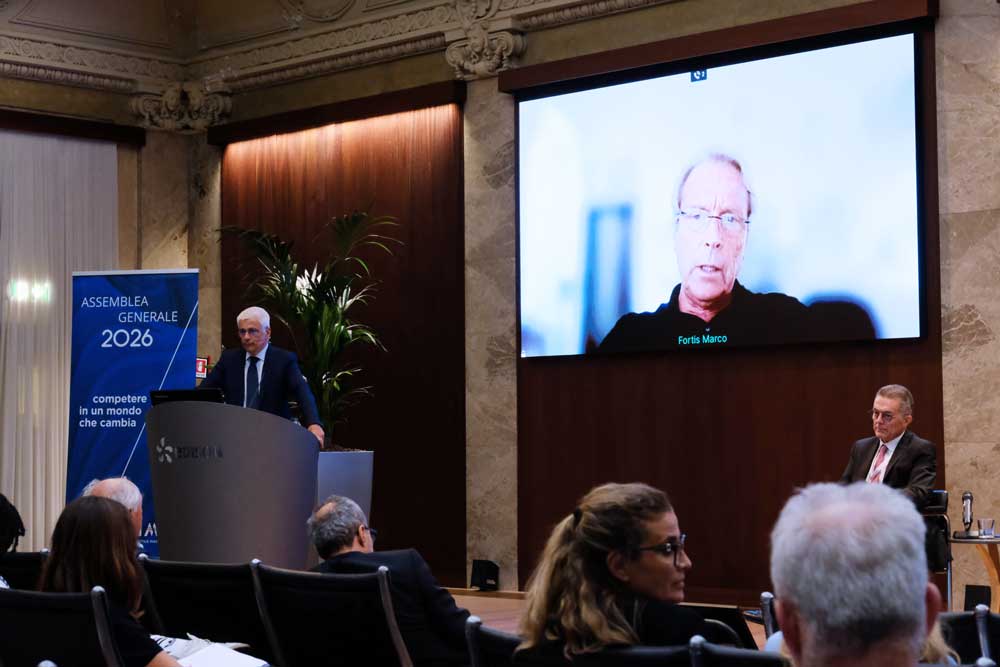
ACIMIT (Association of Italian Textile Machinery Manufacturers) held its General Assembly on 1 July 2026 in Milan at the Shareholders’ Hall of Palazzo Edison, where the Italian textile machinery industry described a scenario characterized by geopolitical instability, slowing industrial investments, and new protectionist pressures.
President Marco Salvadè presented the sector’s final figures for 2025, based on ISTAT data, noting that weakness in the European and global manufacturing framework conditioned the sector’s results. Despite instability and contraction in traditional markets, Italian technology maintained its position as a global player, according to the association.
Salvadè said the path to revival goes through innovation, sustainable transition, and preparation for ITMA 2027.
In 2025, domestic production in the textile machinery sector stood at approximately Euro 1.94 billion, a 9% decrease compared to the previous year. Exports also contracted, falling 8% to a total value of Euro 1.675 billion. On the domestic front, home sales amounted to Euro 266 million, down 14%, reflecting demand that, while showing moderate growth in overall domestic consumption due to rising imports (+14%), remained insufficient to trigger a significant acceleration in national investments.
The decline in Italian exports affected several traditional target markets, including North America and Turkey, with the latter experiencing a particularly difficult trend. Asia remained the primary destination, absorbing 40% of total exports (Euro 667 million), followed by the European Union (24%) and non-EU Europe (11%). By product category, finishing and dyeing machinery led overseas sales at 33% of the total, followed by accessories (20%) and spinning machinery (15%).
India’s performance stood out amid the broader downturn. In 2025, it became the top market for Italian textile machinery exports, with sales rising to Euro 176 million, up 28% compared to 2024 – a result the association attributed to the dynamism of the local supply chain and the recognized value of Italian technological quality.
Salvadè said the 2025 data require attention but should be read within an unprecedented and fragmented global economic situation, adding that the sector competes globally through technological quality and customized, high-value-added solutions. He reiterated to institutions the need for coherent industrial policies, with incentive tools for innovation and digitalization that are stable over time and easily accessible.
According to ACIMIT, sustainability remains a competitive pillar of Italian technology, with manufacturers continuing to invest in research and development to develop energy-efficient machinery and automation, alongside solutions aimed at reducing the consumption of customer textile companies while also lowering production costs.
Salvadè said the ecological transition is no longer an optional accessory but a main distinguishing feature in international markets, adding that strengthening dialogue with the school and research systems to attract young talent is a priority, since skills are necessary for innovation.
If 2025 was described as a year of transition and resilience, the 2026–2027 period will focus on preparation and global relaunch, with attention on ITMA 2027, the sector’s major international trade event, taking place from 16 to 22 September 2027, in Hanover, Germany. ACIMIT has launched internationalization programs, including promotional activities carried out in coordination with the Italian Trade Agency (ICE) and the Ministry of Foreign Affairs.
These developments were also addressed at the subsequent Public Assembly, titled ‘Competing in a Changing World’. The discussion, moderated by Luca Orlando, journalist and correspondent for Il Sole 24 Ore, brought together representatives from institutions and the economic and manufacturing sectors.
In addition to Salvadè’s report, the event included macroeconomic and geopolitical perspectives from Marco Fortis, vice president of the Edison Foundation, and Paolo Magri, chairman of the ISPI Scientific Committee. The discussion also addressed supply chain and European market challenges, with contributions from Luca Sburlati, president of Confindustria Moda, and Dirk Vantyghem, director general of Euratex.
Speakers said the ability to act as a cohesive system, combined with a commitment to flexibility, innovation, and quality, are factors supporting the global position of Italian-made products.
ACIMIT was founded in 1945 with the objective of promoting the Italian textile machinery industry, supporting its activities both in Italy and abroad. A non-profit organization, it brings together approximately 200 textile machinery manufacturers representing 85% of the sector’s turnover in Italy, for a total value of about Euro 2.1 billion, of which approximately 86% is exported to 130 countries. The technologies produced are divided into categories including spinning, weaving, knitting, finishing, and other machinery.