
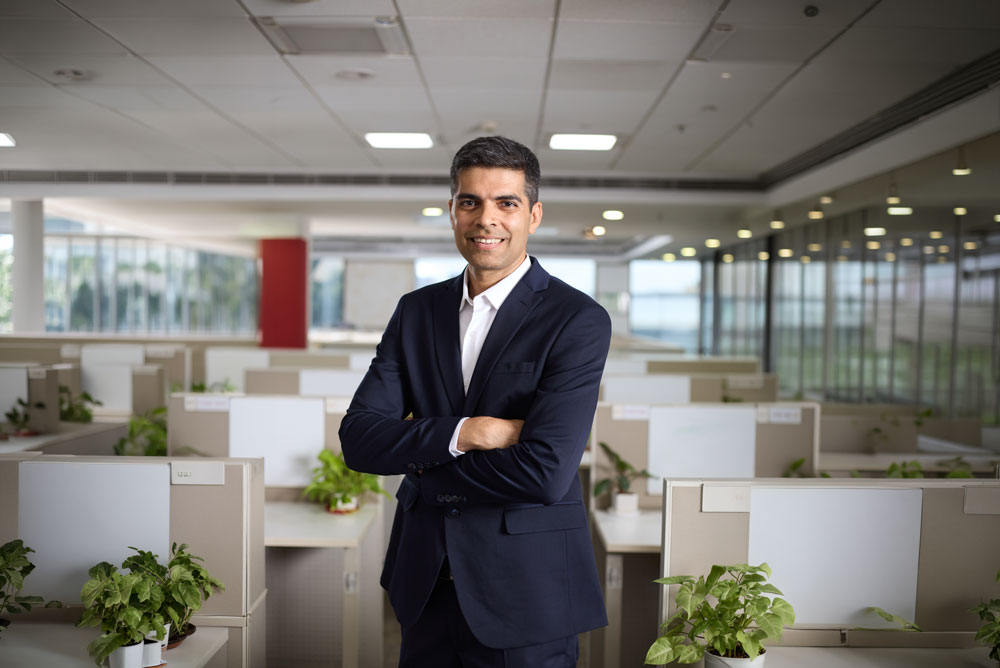
At Bharat Tex 2026, Ester Industries showcased how specialty polyester technologies are reshaping the future of textiles, with sustainability, innovation and recycling at the core of its strategy. Speaking with Textile Vista, Vaibhav Jha, CEO of Ester Industries, highlighted the company’s transformation into a technology-led specialty materials player and outlined how advanced polyester solutions are helping textile manufacturers improve performance while lowering their environmental footprint.
“We have many interesting products for the Indian and global textile industries,” said Vaibhav. “Along with our specialty polyesters for applications such as stain-resistant nylon yarns, low-melt polyester adhesives for monomaterial polyester carpets and various products for polyester yarns, we are showcasing textile-grade recycled PET and creating awareness about our upcoming textile-to-textile chemical recycling project. All these initiatives are closely linked to the textile industry.”
Ester strengthens its specialty polyester portfolio
The company’s evolution has been driven by sustained investments in innovation rather than a change in direction. According to him, Ester has always believed in technology, but in recent years it has accelerated its focus on specialty materials by strengthening research and development, investing in technical talent and engaging closely with markets that demand differentiated solutions. “These three pillars have enabled our transformation,” he explained.
Among Ester’s most successful innovations is its patented stain-resistant masterbatch for nylon yarns, designed to overcome one of nylon’s inherent staining characteristics. The company is also witnessing strong global demand for its easy-dyeable polyester masterbatch, which allows polyester to be dyed at lower temperatures while improving color brightness and color fastness.
“This technology reduces energy consumption during dyeing while also lowering dye usage, making the process significantly more sustainable. It can also be used for enabling printing on polyester carpets thus reducing cost vis a vis nylon carpets which are usually used for printing applications,” he noted. Beyond these, Ester continues to see growing demand for flame-retardant grades, high- and low-intrinsic-viscosity recycled PET solutions, and Bio-PET products manufactured using recycled feedstock. Unlike conventional Bio-PET, where only the MEG component is bio-based, Ester combines bio-MEG with recycled PTA to deliver what it describes as a fully sustainable Bio-PET solution.
Building circularity through polyester innovation
Another significant innovation on display was Ester’s patented mono-material PET laminate solution. Flexible packaging traditionally combines multiple materials that are difficult to recycle after use, but the company’s latest development seeks to address this long-standing challenge.
“So far, no one has been able to establish mono-material polyester films in the way we have,” he said. “Our patented ultra-high heat seal solution enables brands to have laminate structures made entirely from polyester, and these can also be produced using 100% recycled content.”
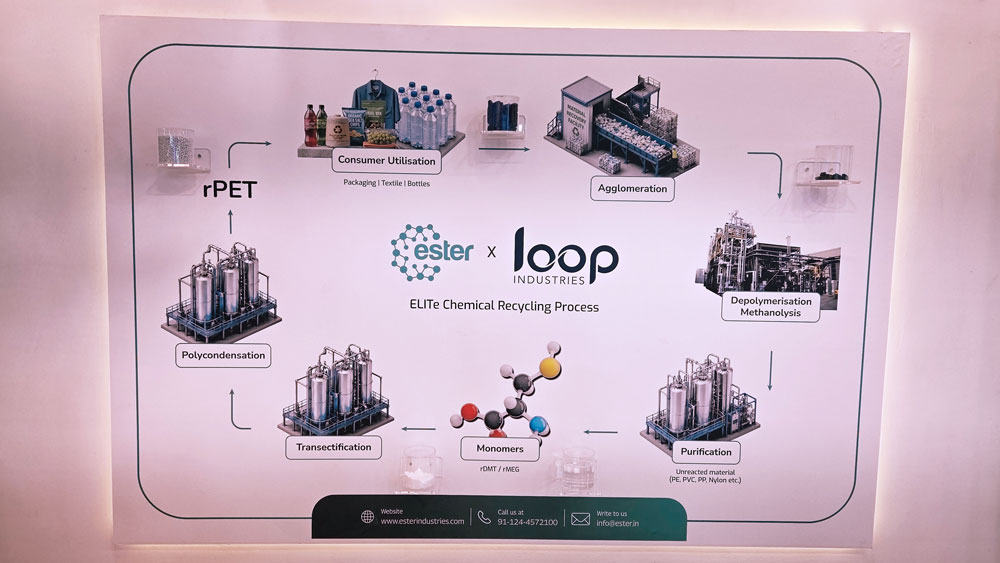
He explained that the innovation keeps packaging within a single material family, significantly improving recyclability without compromising performance. Complementing this technology is Ester’s planned investment of more than INR 1,000 crore in Elite Ester Loop Infinite Technologies. The facility is being developed primarily for textile-to-textile recycling while also supporting bottle-to-bottle and laminate-to-laminate recycling, thereby strengthening polyester circularity across multiple sectors.
“We will use recycled polyester to manufacture ultra-high heat-seal laminate structures. After consumer use, these laminates can be collected and recycled through our Elite technology back into polyester, which can again be used to manufacture the same laminate. For the first time, we will be able to demonstrate true circularity for polyester laminates,” he added.
For Vaibhav, polyester remains central to the global sustainability agenda. “Polyester is the magic material for this global sustainability push,” he said. “Its chemical structure makes it highly recyclable. We have already seen success in recycling PET bottles, and now technologies are emerging to recycle polyester textiles and laminates as well. Sustainability solutions based on polyester will witness the biggest demand.”
Ester’s recycled PET portfolio is helping textile manufacturers reduce carbon emissions while its easy-dyeable technology delivers environmental benefits through lower energy consumption and reduced dye discharge. The company’s recycled flame-retardant products and recycled high-tenacity polyester chips further support manufacturers looking to improve sustainability without compromising performance. Many of these products also find applications in the technical textiles segment.
Looking at the broader market, he believes India’s position in the global textile value chain is strengthening rapidly. The China-plus-one strategy, new free trade agreements with key export markets and government initiatives such as PM MITRA are together creating favorable conditions for India’s textile industry.
India’s textile industry poised for global growth
“India is becoming increasingly important as a global textile manufacturing and sourcing destination,” he observed. “Government support and improved market access through FTAs will significantly boost textile exports in the coming years.”
On the challenge of balancing sustainability with affordability, he argued that while sustainable materials may initially command a premium, the cost impact on finished consumer products remains minimal. “When you look at the final retail price of a branded garment, the additional cost of sustainable yarn is only a very small fraction. Consumers are unlikely to feel the difference, while the environmental benefits are substantial,” he said.
Reflecting on Bharat Tex 2026, Vaibhav expressed confidence in the exhibition’s growing international stature. “The response has been fabulous. This is the premier textile exhibition in India, and with global buyers increasingly looking towards India, we have seen strong participation from international delegations as well,” he concluded.